Showing posts with label water policy. Show all posts

Wednesday, December 16, 2009

Giving Away Our Water

Imagine the civil government issuing you an order to pump water out of your well, on your property, to your neighbors' homes.
Imagine that same government agency telling you that you had no right to the water in that well, and that you needed to find another source of water for your home, and compliance to their orders would be at the point of a gun if you could not "work it out."
What would you do? How would you react?

The State of Georgia, where I reside, is in that very situation, and our leaders are not reacting the way you might in the above "imaginary" example.

Yesterday, the Governor of Georgia, Sonny Purdue, met with the Governors of Florida and Alabama, our State's neighbors in Montgomery, AL to discuss how we might comply.

Please don't get me wrong: I'm not suggesting that we should ignore the needs of Florida and Alabama. Going back to our "imaginary" scenario, and removing the outside influence of the civil government; who among us would be so uncaring as to not give that needy neighbor a gallon or bucket or whatever we could spare? Who would not help their neighbor build their own water system?

Yet meetings like this, under the misplaced thumb of an out-of-control government not only undermine any good and positive relations we might have been able to build with our neighbors, it also puts them in a tough spot: they asked the feds to rule here, so when the feds come after their States' natural resources, they'll have a much harder time saying no.
Unintended Consequences.

Now, this may be a bit of a strong position for your taste, but States' Rights advocate and 2010 Georgia Gubernatorial candidate Ray McBerry's position on water is certainly closer to my sentiments than that of the current administration. Have a listen.


The notion that neither the federal government nor the state own or have rights to natural resources seems primary to our nation's founding.
Maybe we'll get some leadership in Georgia who agrees with that position, for a change.


Wednesday, May 6, 2009

Sometime back, we told you about the Georgia Regional Water Councils and the impact they will have on water policy for the entire state of Georgia.
view this map @ http://www.georgiawaterplanning.org/Files_PDF/basin_map.pdf

THEY ARE MEETING, AND THEY NEED TO HEAR FROM US!


Please attend the meeting in your area if it has not already been held. If it has already been held, contact the contact person and ask them to send you information of the past meeting and notices of future meetings. 

The Altamaha Regional Water Planning Council is holding its next meeting at the following time, date and location: 9:00 a.m. – 4:30 p.m., May 5, 2009, Southeastern Technical College – Vidalia Economic Development Center, 100 A Brinson Road, Vidalia, GA 30474 

For additional information about the Altamaha Regional Water Planning Council please contact:
Kevin Farrell, Assistant Branch Chief – EPD Watershed Protection Branch, 404-675-1621, Kevin.Farrell@dnr.state.ga.us

The Coastal Georgia Regional Water Planning Council is holding its next meeting at the following time, date and location: 9:00 a.m. – 4:30 p.m., May 4, 2009, J.F. Gregory Park, Stevens Wetlands Education Center, Cedar Street Richmond Hill, GA 31324 

For additional information about the Coastal Georgia Regional Water Planning Council please contact:
Jeff Larson, Assistant Branch Chief – EPD Watershed Protection Branch , 404-675-1664, Jeff.Larson@dnr.state.ga.us

The Coosa-North Georgia Regional Water Planning Council is holding its next meeting at the following time, date and location: 9:00 a.m. – 4:30 p.m., May 8, 2009, Appalachian Tech , 100 Campus Drive; Jasper, GA 30143 

For additional information about the Coosa-North Georgia Regional Water Planning Council please contact:
Becky Champion, Assistant Branch Chief – EPD Watershed Protection Branch, 706-888-8351, Becky.Champion@dnr.state.ga.us

The Lower Flint-Ochlockonee Regional Water Planning Council is holding its next meeting at the following time, date and location: 9:00 a.m. – 4:30 p.m., May 6, 2009, Mitchell County EMC, 475 Cairo Highway, Camilla, GA 31730

For additional information about the Lower Flint-Ochlockonee Regional Water Planning Council please contact: 
Tim Cash, Assistant Branch Chief - EPD Watershed Protection Branch, 404-675-1766, Tim.Cash@dnr.state.ga.us

The Middle Chattahoochee Regional Water Planning Council is holding its next meeting at the following time, date and location: 9:00 a.m. – 4:30 p.m., May 13, 2009, Callaway Gardens – Dogwood Room Mountain Creek Inn, 17800 US Hwy 27, Pine Mountain, GA 31822 

For additional information about the Middle Chattahoochee Regional Water Planning Council please contact: 
Tim Cash, Assistant Branch Chief - EPD Watershed Protection Branch, 404-675-1766, Tim.Cash@dnr.state.ga.us

The Middle Ocmulgee Regional Water Planning Council is holding its next meeting at the following time, date and location: 9:00 a.m. – 4:30 p.m., May 14, 2009, Amerson Water Treatment Plant, 703 Riverbend Road, Macon, GA 31211 

For additional information about the Middle Ocmulgee Regional Water Planning Council please contact: 
Kevin Farrell, Assistant Branch Chief – EPD Watershed Protection Branch, 404-675-1621, Kevin.Farrell@dnr.state.ga.us 

The Savannah-Upper Ogeechee Regional Water Planning Council is holding its next meeting at the following time, date and location: 9:00 a.m. – 4:30 p.m., May 7, 2009, Savannah Rapids Pavilion ,3300 Evans to Locks Road – Martinez, GA 30907 

For additional information about the Savannah-Upper Ogeechee Regional Water Planning Council please contact: 
Jeff Larson, Assistant Branch Chief – EPD Watershed Protection Branch, 404-675-1664, Jeff.Larson@dnr.state.ga.us

The Suwannee-Satilla Regional Water Planning Council is holding its next meeting at the following time, date and location: 9:00 a.m. – 4:30 p.m., May 6, 2009, C. E. Weir Center, 307 Bryan Street East, Douglas, GA 31533 

For additional information about the Suwannee-Satilla Regional Water Planning Council please contact:
Rob McDowell, Assistant Branch Chief – EPD Watershed Protection Branch, 404-675-1650, Rob.McDowell@dnr.state.ga.us

The Upper Flint Regional Water Planning Council is holding its next meeting at the following time, date and location: 9:00 a.m. – 4:30 p.m., May 1, 2009, One Griffin Center, Commissioner’s Meeting Room, 100 South Hill Street Griffin, GA 30223 

For additional information about the Upper Flint Regional Water Planning Council please contact: 
Tim Cash, Assistant Branch Chief - EPD Watershed Protection Branch' 404-675-1766, Tim.Cash@dnr.state.ga.us

The Upper Oconee Regional Water Planning Council is holding its next meeting at the following time, date and location: 9:00 a.m. – 4:30 p.m., May 8, 2009, Rock Eagle 4H Center – Rich Building ,350 Rock Eagle Road, Eatonton, GA 31024 

For additional information about the Upper Oconee Regional Water Planning Council please contact: 
Kevin Farrell, Assistant Branch Chief – EPD Watershed Protection Branch, 404-675-1621, Kevin.Farrell@dnr.state.ga.us
Saturday, February 14, 2009

Where Will You Get Your Water?


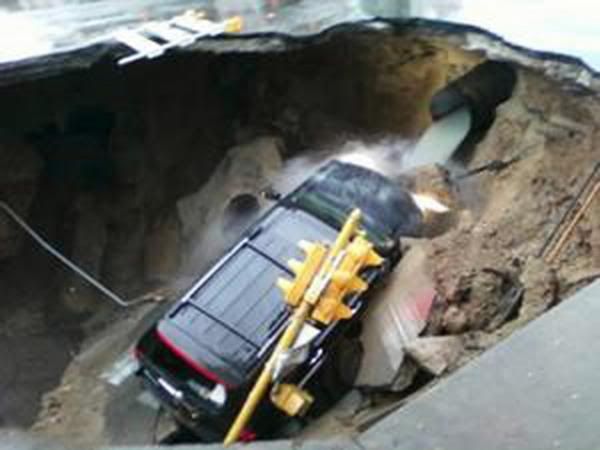
Sinkholes like this have become nearly
epidemic all over the US as old pipes
begin to fail.
As a water professional who has lived in the Metro Atlanta, Georgia area all my life, I’ve developed a sort of unique perspective on local happenings. A few years back, following all our Olympic glory and in the middle of a huge developmental boom, we began to see roads collapsing and washing away all over the city- it seemed like a new incident was broadcast every night on the news. Our 80+ year-old infrastructure was in trouble- and there was no money to fix it.
Mayor Shirley Franklin stepped up and took a bold stance- she became modern America’s first “Infrastructure Mayor”, committing to repair and upgrade the City’s infrastructure in her term of office.
Upset Atlantans protest the proposed
closure of West End Station #7.
By in large, the citizens of the Atlanta got behind her- I mean- it sounded like a good idea, right?
Here’s the problem: it is very expensive, it takes a long time, and it's product is not visible.
So- what sounded like a good idea to everyone back then is becoming a hassle as we attempt to navigate our streets and get frustrated with the constant construction traffic. What sounded great before sounds less and less warm and fuzzy with every fire station that faces closure. Infrastructure, and Mayor Franklin, are becoming less and less popular.

As I write this article, the Georgia Legislature begins its 2009 session with a $2.5 Billion deficit, and Atlanta’s could top $80 Million- one of the largest in the nation. With lawmakers calling for a truly balanced budget, will this be the end of Atlanta's commitment to infrastructure?

There is another way- one I recently wrote about:


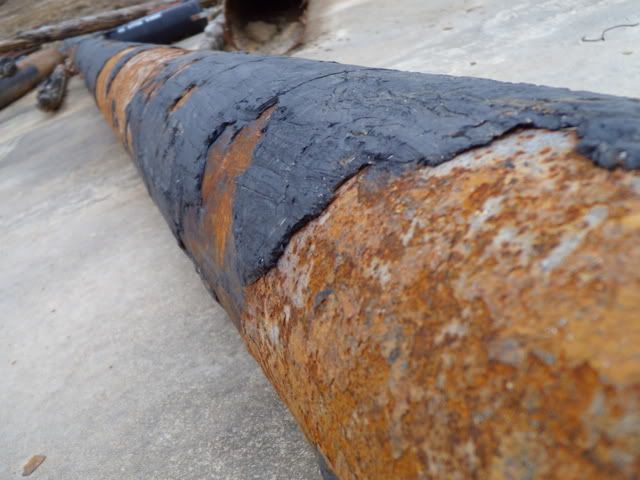
Rusty supply lines are one of the biggest
threats to US drinking water.
In Detroit, Michigan, their Mayor recently appointed Victor Mercado, a private water industry tycoon, head of the city’s troubled water works. While the system continues to run down, the city has reduced its repair workload, instead focusing its resources on disconnecting delinquent customers. They disconnected over 40,000 customers last year, and had proposed to double that number this year. Now that number will surely adjust upward in light of new economic stresses on Government and citizens.
Potentially, after 2 year’s time, that city will wake up to find nearly 200,000 households without water coupled with little or no positive action toward a rapidly failing infrastructure.
Running the system down, starving it of capital: these are the kinds of measures we usually see in the corporate world before a “hostile takeover”.
Once a system is too far gone, the citizens will accept any alternative, and government will be happy to get the “hot potato” out of their hands at any cost.

Like roads and bridges, water infrastructure is one of the basic services we believe should be available and provided by government. Without water, a city cannot flourish. Without water, people cannot live. Without government protecting and providing citizens access to this basic need, these Profiteers can and will sell their commodity to the highest bidder, and many hundreds of thousands- even millions- may find their interest taking a back seat to industry, by far the largest and most lucrative consumer of water in the world.

If you think this is not possible- take a look at what the World Bank is already doing in third-world nations all over the globe. Water is now treated as a global commodity, and multinational corporations are buying up the rights to that water as quickly as they can. Water which had, for centuries, completely provided for entire self-sustaining communities is suddenly becoming a luxury which poor families simply cannot afford.

Our American lifestyles are highly dependant on access to a lot of water. But on a level of necessity I see very few issues that could be more important than where our water will come from in the future. If we don’t know the answer to this question, we should begin to understand what is happening to infrastructure around us, and begin looking at all options to protect our own access. We should contact our legislators and let them know that we do not want any infrastructure to be privatized. We should ask them to commit to protect the rights of private citizens to collect water off their own property- including by wells and rain cisterns. We should let them know that we expect them to favor individuals’ access to water over corporate agendas. Water is fundamental to life. Are we really willing to give that up?

Thursday, February 12, 2009

Georgia Regional Water Planning Council Appointments

In August of last year, a call went out to all water professionals re: The Georgia Regional Water Planning Councils.  It read something like this: 

If your business involves WATER or WASTEWATER in any way, you must be involved in the Regional Water Planning Councils which will be appointed by the Governor, Lt. Governor and Speaker of the House.   These Councils will determine all rules and regulations for water and wastewater for the future.   Don’t be bashful about completing this form and nominating yourself.  YOU are one of the most knowledgeable people on this subject and the councils need YOUR input.   Believe me, government officials and all the environmental groups WILL be well represented on these councils.  Professionals in the industry MUST also be represented and this is YOU!  If industry is not represented, we could be regulated out of business!

...sorta ominous sounding, huh?  


I, for one, jumped on it- I certainly don't want to be regulated out of business!  I submitted my nomination and waited.  And waited.  As it turned out, my region- representing the Greater Metro ATL, was already seated, and had been working toward rules and guidelines which would facilitate this greater, more inclusive group.


So, now, 6-months into the 3-year study, 10 councils of 30 members each have finally been announced.  


Here are the ex-officios for each of the respective councils:


Altamaha Rep. Greg Morriss Sen. Tommie Williams

Coastal Georgia Rep. Cecily Hill Sen. Eric Johnson

Coosa- N. Georgia Rep. Katy Dempsey Sen. Chip Pearson

Lower Flint - Ochlockonee Rep. Gerald Greene Sen. John Bulloch

Middle Chattahoochee Rep. Bob Hanner Sen. Bill Heath

Middle Ocmulgee Rep. David Knight Sen. Ross Tolleson

Savannah - Upper Ogeechee Rep. Tom McCall Sen. Ralph Hudgens

Suwannee - Satilla Rep. Jay Shaw Sen. Greg Goggins

Upper Flint Rep. Lynmore James Sen. George Hooks

Upper Oconee Rep. Terry England Sen. Bill Cowsert


If any of these individuals represent you, please contact them and let them know that you expect them to rule on the side of private property and individual citizen's rights over corporate interests, especially as it regards to well ownership and rain water harvesting.


Friday, February 6, 2009

MTR and Water Legislation

There are likely few-to-no truly honest folks who can look at the impact of Mountain Top Removal (MTR) and not be upset.  Called "strip mining on steroids", MTR has destroyed over 2,500 peaks in southern Appalachia to generate less than 5% of the country's energy needs.  Besides destroying mountain vistas and leaving undesirable and unusable land in its wake, it has left over 1,200 miles of head water streams buried under toxic rubble.
A 2002 Army Corps of Engineers rule allows waste generated by this practice to be classified as "fill", even though it has been found to contain extremely high levels of arsenic and mercury.  

Environmental activists and conservationists, finding the fighting in court, and at the local and state levels difficult,  have turned their attention to a piece of Federal Legislation. Rather than specifically addressing the issue, these groups have gotten behind broader legislation in the Clean Water Protection Act- HR 2169, formerly HB 2421. see correction  

As much as I can sympathize and stand with those who would see MTR stopped,  I cannot get behind this dangerous piece of legislation.
It is the opinion of several property rights advocacy groups that this act, if ratified, will centralize control of every drop of water and every piece of land in the United States.  It does this by reclassifying all water in and on US Soil as "navigable", thereby giving it the same federal protection that is afforded shipping lanes.  That water would then be FEDERAL PROPERTY.
Sure, it would stop the wanton destruction of mountain streams, but would also facilitate the biggest land grab in history!  Well owners would find their water metered, and even municipal water customers could face rations.see correction  

Sure, Mountain Top Removal is really bad and should be stopped.  But we should always be sure that before we call for "somebody" to do "something", we understand the full implications of our cries. 

Click here to learn more about HR2421 and what you can do to stop it.


Friday, January 30, 2009

Deadly Water, Corporate Scandals, and Presidential Politics- OH MY!

From Water Tech Online: Water Industry News and Information Clearinghouse
http://www.watertechonline.com/news.asp?N_ID=71314

Vote for the top e-News story of 2008
-and with topics like these, you may just have a hard time choosing!
A list of the 10 most popular 2008 WaterTech e-News Daily® stories, based on numbers of readers clicking on them throughout the year, has now been compiled by the staff of WaterTech Online® Web site and the WaterTech e-News Daily electronic newsletter. In a new online poll, readers can now vote for the story among the 10 that they think was “most significant.”

I find it most notable that 3 of the top 10 news stories reported on Pentair, the largest supplier of components and subsystems for the handling, treatment and storage of water.  That, coupled with the news that water is now a $1 Trillion industry... big water is here, folks!


Also of note: the Nestle Waters NA/ Public Works fight over a PSA which promoted tap water over bottled.  Marry that to the Colorado story of deadly salmonilla in tap water...


Of course, stories about President Barack Obama’s attention to water issues also garnered a significant number of clicks.


Log on, click around, connect the dots as you see fit!  Its all fun and games 'long as it keeps flowing!